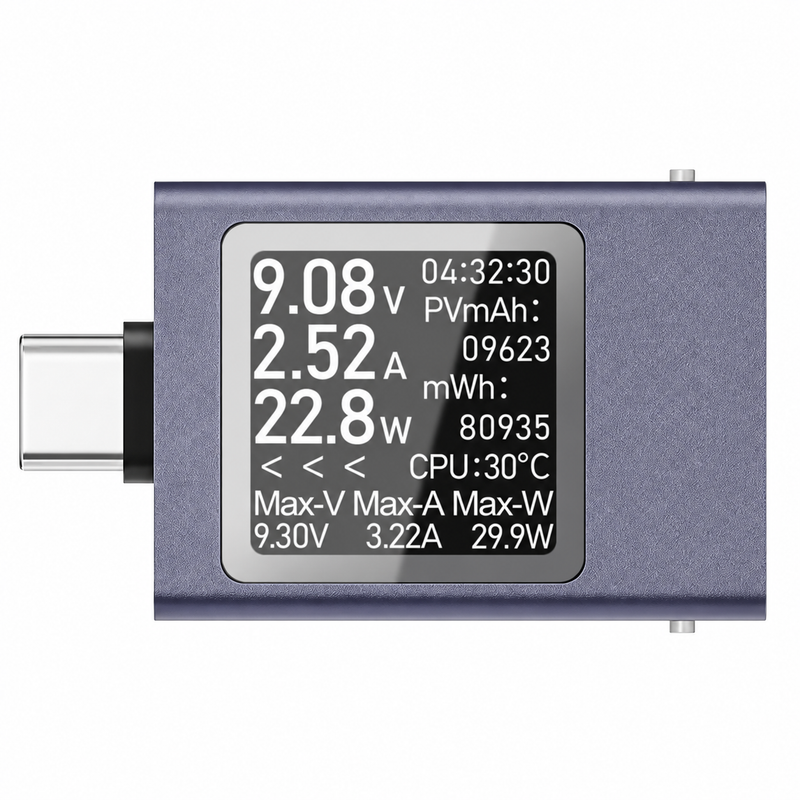
USB-C PD Power Meter — Voltage, Current & Protocol Tester (PD3.1, PPS, QC)
$29.00
Ships in approximately 3 weeks
Ships Australia-wide via tracked post
Product Details
Many people already own a USB-C charger that could power a retro console — a laptop charger, a desktop power station, a spare left over from an old device. The question is whether it actually supplies the voltage and current your console needs, and that is rarely clear from the box.
This meter answers it. Plug it in between the charger and your console's USB-C adapter or cable, and it shows exactly what the charger is delivering — before you trust it with the console.
Why It Matters
- Too little voltage or current — an undervolted console is an unstable one: crashes, resets, glitching, or refusing to start at all. Plenty of capable chargers skip the 12 V profile entirely, or offer it at reduced current on some of their ports.
- Too much voltage — a charger that does not behave the way its label claims can supply more than the console is designed for, and that risks permanent damage. Checking first costs nothing; replacing a thirty-year-old console is another matter.
Check The Label First
A well-labelled charger lists each port separately, something like:
- C1 or C2: 5V/3A · 9V/3A · 12V/3A · 15V/3A · 20V/5A
- C3: 5V/3A · 9V/2.22A · 12V/1.5A
On that charger, C1 and C2 would run a 12 V / 3 A console adapter and C3 would not — despite all three being USB-C ports on the same unit. Where the label is vague, worn off, or quotes only a total wattage, the meter gives you the real figures instead.
What It Shows
- Live voltage, current and power on a clear digital display
- Peak readings — the highest voltage, current and power seen, so a brief spike cannot slip past unnoticed
- Energy delivered in mAh and mWh, with an elapsed-time counter
- Internal temperature
Protocol Support
Detects and tests a broad range of fast-charge protocols: PD2.0, PD3.0, PD3.1, PPS, QC2.0, QC3.0, FCP, SCP, AFC, PE, DASH, VOOC and SuperVOOC.
Good to Know
This is a measurement tool, not a power supply — it reports what passes through it and does not change or regulate it. Sold as a single meter.
Shipping & Collection
Ships Australia-wide via tracked post. Perth locals may also arrange local collection — contact us to arrange.